
I wasted most of Sunday afternoon attempting to write an obituary for Mike Westbrook but quickly tired myself out, or was tired out by the procession of facts and statistics which necessarily accompany a long and active life. If you want The Facts and a considered opinion, read Richard Williams’ definitive obituary in The Guardian. Born in 1964, I was too young to witness the alleged golden years of Surman & co., mention of which always drove Westbrook politely apoplectic; just as people who claim to like Bowie actually only have time for the eighteen months he spent playing Ziggy Stardust, so do Westbrook “fans” focus on the anarchic punk rock-like explosions his Concert Band unleashed over the last three years of the sixties.
In actual fact the sixties were a terrible time for British jazz musicians who made scarcely any money from music, mostly had to fall back on day jobs, student grants or session work to pay their way and had to deal with an entrenched – some would suggest entombed – establishment who viewed jazz as synonymous with cricket. The Concert Band which recorded Release and were at the core of Marching Song were essentially two separate and musically polar-opposite bands deliberately shoved together who in some cases positively loathed what the other half was doing.
Concentration on that tiny but, for tax loss reasons, well-documented period of Westbrook’s career purposely misses out the subsequent fifty-five years he spent expanding the language and reference points of British jazz, incorporating art music, rock, folk, cabaret, theatre and much besides. This he mostly did in direct collaboration with his second wife Kate, who was hurriedly and predictably damned as British jazz’s Yoko Ono and yet was clearly and palpably his muse. Citadel/Room 315 was named after a room in one of the buildings of Leeds Polytechnic, where Kate was then teaching art, which contained a piano and which Westbrook therefore used (and on which he composed the piece) when he was up visiting. that she used while teaching there and is a transitional work in that it wraps up and bids farewell to the John Surman era – Surman himself being the work’s main soloist – while welcoming a new and richer one (although contemporary accounts tend to put a gloss on how things were between the composer and the saxophonist; Surman’s departure from Westbrook’s band in 1969, as any reader of the period’s jazz music press would have known, was acrimonious and bitter, and Citadel helped to resolve it).
Yet the work that both Westbrooks did after Citadel – astonishing in scope and approach – proved mature and lasting, and such later large-scale works as The Cortège and London Bridge Is Broken Down dwarf their predecessors in scale and quality. Bright As Fire, the second and by some distance best recording of Westbrook’s adaptations of the poems of William Blake, would have stood as a phenomenal achievement in any era, let alone the 1980 in which it was released, and the “Let The Slave/The Price Of Experience” medley, with Phil Minton singing the former, Westbrook reciting the latter and Alan Wakeman’s tenor blowing its heart out, is one of the highlights of British recorded music, full stop. His 1989 Beatles adaptation Off Abbey Road was one of the best and most original of Fabs reinterpretations, with Westbrook cleverly giving McCartney’s bass-playing role to Andy Grappy’s tuba.
Westbrook did not run “bands” – and even then these were many, from the jazz-rock-poetry adventures of Solid Gold Cadillac and the purposely utilitarian Brass Band to the later, Devon-based Uncommon Orchestra, let alone numerous duos, trios etc. – so much as a repertory company, utilising the cast of musicians available to him as and when a specific piece demanded. In return he commanded a quite astonishing degree of loyalty, where key musicians stayed in his orbit, on call, for decades. Fellow Torquay inhabitant Phil Minton, who first played trumpet in Westbrook’s rehearsal bands of the fifties, was still there as an utterly unique vocalist virtually to the end (he had left the band full-time some years ago but regularly returned as a guest). Trumpeter Dave Holdsworth, who played on Westbrook’s first album, 1967’s Celebration, remained present on 2016’s A Bigger Show; tenorist Lou Gare, who played in Westbrook’s early large bands with Keith Rowe and Lawrence Sheaff before all three left to help form AMM, returned to the composer’s band in his final years. Saxophonists Chris Biscoe and Alan Wakeman were in and out of Westbrook’s various bands for the best part of half a century.
The man remained immensely active for all of his professional life. Perhaps one should preserve unrecorded (and possibly unrecordable) affairs like 1969’s multimedia Earthrise in the imagination; I was obviously too young and far away at the time to see it at the Mermaid Theatre, but note that contemporary reviews were rather muted – apart from typically crochety old-jazzmen grouching about the light show giving them a headache, Westbrook appeared to have fielded a band of reserves rather than first-call players. Similarly, epics like the seven-hour interlinked improvisational marathon Copan/Backing Track are probably better imagined than experienced.
There was, of course, always a theatrical element to Westbrook’s work. I remember staying up late one Saturday evening to watch his and John Fox’s Original Peter presentation on BBC2; everyone mucked in for a Happening about a year after such things had gone out of fashion. The accompanying Love Songs album, though poorly mixed and badly received at the time, surprisingly gained a very favourable reassessment when reissued in the 2000s, much to the chagrin of Westbrook, who didn’t feel that the record achieved what he and his band had set out to capture. The decade-long involvement of the People Band/Show’s George Khan in various Westbrook bands did of course add to this outlook. But Mama Chicago (1979), After Smith’s Hotel (1983), Platterback (1998) and the aforementioned A Bigger Show confirmed Westbrook’s theatrical vision and range to be undiminished.
Westbrook composed soundtracks for television plays, briefly united his Orchestra with the group Henry Cow – both Lindsay Cooper and Georgie Born from the latter played key roles in The Cortège – and even worked with Van Morrison on the latter’s characteristically idiosyncratic 1985 reading of “Let The Slave/The Price Of Experience.” Like Stan Tracey, he was working and planning right up to the end; his recent series of solo piano recitals serve as a very elegant conclusion to a rich, creative and fulfilling life – 2018’s Starcross Bridge, dedicated to Kate, is one of recorded music’s most moving extended love letters. He has left us an immense legacy of music to explore, be provoked by and enjoy. Along with Carla Bley and Keith Tippett, he is one of the three musical figures who did most to structure my feelings about music as a teenager. Now all three have gone, more or less in the space of half a decade. Rest well.
Recommended Records
(N.B.: this is NOT a complete or definitive list of Westbrook’s recorded works – just my personal favourites. Behind each album stand at least three or four others. The long chronological gap at the end of this list has more to do with the fact that most of what was released in that period was primarily, or solely, in Kate’s name – and those records deserve an evaluation of their own. Best curate’s egg: Love Songs [Deram, 1970] – the music here deserved better [in particular a better production, and perhaps more rehearsal time] than it got, but one can’t deny the glory of “Original Peter” with its unending fadeout [there’s no shutting up George Khan, even though drummer Alan Jackson very audibly tries to wind things up right at the end] or Norma Winstone and Mike Osborne on “Love Song No 4,” one of the great recorded duo improvisations in British jazz.)

Celebration (Deram,1967): his first album and a remarkable statement of intent in the milieu of mid-sixties British jazz, featuring the then practically unknown John Surman and Mike Osborne as its principal soloists, to dramatic effect.

Release (Deram, 1968): scheduled ahead of Marching Song by a nervous Deram but an exhilarating 55-minute (almost) non-stop romp through jazz standards, Westbrook originals and short-sharp-shock free improv. Again Surman and Osborne are the main events solo-wise, but George Khan nearly steals the show with his uncompromising tenor outburst on “Flying Home/Theme One” and Paul Rutherford performs the first recorded multiphonic trombone improvisation on “Folk Song No 1.”
The Last Night At The Old Place (Cadillac, 2018): the Release band performing, about three months before recording the album, at the packed-out last night of Ronnie Scott’s Old Place on Gerrard Street. Although the piece was clearly far from complete, the absence of long-playing-album limitations mean that players like George Khan, Bernie Living and Dave Holdsworth have more time and space to develop and expand their ideas. The recital confirms just how much fun it must have been to play this music.

Marching Song (Deram, 1969): stupidly released by Deram as two separate volumes (all subsequent CD reissues package both parts together); immense, programmatic and onomatopoeic conceptual work about the futility of war, mainly inspired by World War I pseudo-nostalgia and in part by Westbrook’s own experiences while serving in Germany during National Service in the fifties (and not at all by Vietnam) and using twenty-six different musicians in various 15-20 piece permutations, with a double rhythm section throughout, which runs the gamut from straight(ish) jazz to cataclysmic and, even by its period’s standards, exceptionally violent mass free improvisation. But for Westbrook himself, musically this was only a start.
Metropolis (RCA Neon, 1971): as a fifteen-year-old listening to the then recent reissue of this album, I found this noisy-neighbour-battle juxtaposition of free playing, tight R&B/rock riffs and Test Card easy listening music – again there is a double rhythm section; one acoustic, one electric – utterly thrilling. Its day-in-the-life-of-a-big-city theme was inspired by Westbrook’s experience of first coming to London in 1962. Yet its profoundest moments are the quietest ones, namely two exquisite ballad features for the flügelhorns of Henry Lowther and Harry Beckett respectively; Beckett’s soliloquy in particular feels like the final curtain being brought down on the planet.

Citadel/Room 315 (RCA, 1975): John Surman returns as the star soloist as Westbrook says a fond goodbye to his old life (“Outgoing Song”) and a fonder hello to his new one (“Tender Love”). “View From The Drawbridge” is one of the most outstanding achievements in all of recorded British jazz. Yet the section which appears to have endured most readily is the one Surman sits out, the lovely “Pastorale” which spotlights the rest of the orchestra – once again Henry Lowther rises to the occasion as soloist, as does, in his first Westbrook recording, Alan Wakeman. Man of the match: percussionist John Mitchell, who never stops working.

Goose Sauce (Original, 1978): the best of the regular Brass Band recordings – in my view, it beats out Mama Chicago - with Phil Minton, Kate Westbrook, George Khan and Paul Rutherford all in fiery form. “Mourn Not The Dead” remains frighteningly powerful and pertinent.

Bright As Fire: The Westbrook Blake (Original, 1980): with the Brass Band still at its core, this is Westbrook’s crowning achievement. Tyger (RCA, 1970) seemed like preparatory sketches for Blake and Glad Day (Enja, 1997) has its powerful moments, although by then Phil Minton couldn’t quite reach the high notes he’d done before. But Bright As Fire is one of the definitive twentieth-century recordings. Blake’s work has never been interpreted better by anybody, and if “Let The Slave/The Price Of Experience” doesn’t break your heart and make you angry then you don’t have a heart to be broken.

The Cortege (Original, 1982): the 1980 BBC Radio 3 Jazz In Britain session version of this work appeared on CD in late 2025, and although the latter definitely benefits from having Alan Wakeman rather than Phil Todd on tenor, Westbrook was still adding new sections to the piece, including the tribute to his father “Erme Estuary” (which features, amongst other things, Todd’s rather marvellous clarinet lament). So neither version is absolutely definitive, but the triple (!) album which appeared in the immediate aftermath of New Pop is about as great as British jazz and the music of Mike and Kate Westbrook ever got.

On Duke’s Birthday (hatArt, 1985): with Celebration, this is perhaps the ideal point of entry for the Westbrook neophyte – an unconventionally-orchestrated medium-sized band pays eloquent tribute to Ellington without once resorting to imitation or pastiche, expanding the man’s musical language but keeping everything in sufficient order to impress the listener with regard to Westbrook’s talents.

Westbrook-Rossini (hatArt, 1987): outrageous reinvention? Hardly; if anything, the great Pesaro man would probably have adored this glorious seven-piece-band mish-mash of most imaginable musical styles – along with a couple of previously unimaginable ones – which crucially make his music live again.

London Bridge Is Broken Down (Venture, 1988): one of the more pleasing consequences of the eighties jazz “revival” was that major record companies – in this case, Virgin – trusted jazz musicians sufficiently to throw them some money and a contract. Combining a nine-piece band with a 22-piece French orchestra, London Bridge shows how far Westbrook had travelled, as an arranger and organiser of music, in twenty years; the shifting key centres tentatively explored in Metropolis and elsewhere now seem fully realised and evolved. Kate has arguably never sung better than on “Les Morts” but the concluding “Aucassin et Nicolette” was, and remains, as bizarrely uplifting as anything Todd Terry or Kevin Saunderson did that year.
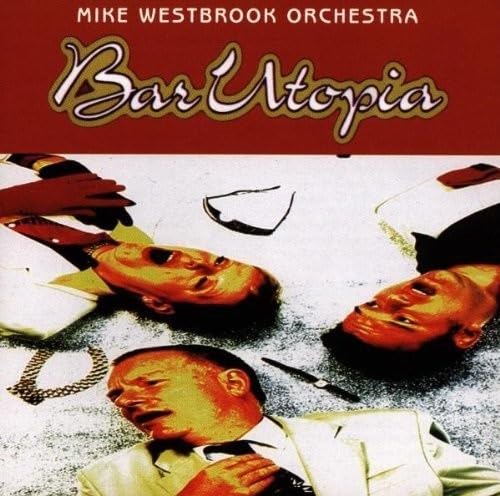
Bar Utopia (Enja, 1996): better realised and performed than Mama Chicago, this is one of Westbrook’s most sheerly entertaining records with fearless ventures into all styles of music, and new singer John Winfield ably makes himself felt. I think RAYE would enjoy this because some of her songs (e.g. “I Hate The Way I Look Today.”) are stylistically not a million miles from some of what goes on here.
Chanson Irresponsable (Enja, 2002): jazz Messiaen? This big band work takes birds and birdsong as its primary inspirations and the piece, divided up yet uniting both jazz and classical musicians at a Keith Tippett level of natural interaction, is realised wonderfully. Person of the match: the young Seb Rochford at the drums.

A Bigger Show (ASC, 2016): that there internet, what’s to be done about it; eh, eh? Utilising a double rhythm section for the first time since Metropolis – except this time there are two guitars – this gargantuan work was Westbrook’s final, and best, big band composition. Everybody, especially altoist Roz Harding (as great as Mike Osborne was in the olden days), is absolutely on fire, the music is angry yet jovial, and Westbrook’s end credits shoutout shows that RAYE’s “Fin.” – either of them - didn’t spring from nowhere. If you have to have one Westbrook big band album, make it this one.

Starcross Bridge (hatArt, 2018): I think we can sum up and conclude Westbrook’s work here – just the man himself, alone at the piano, playing love songs to the love of his life in the way only he could. The segue from “I Got It Bad – And That Ain’t Good” through “View From The Drawbridge” and into Thom Bell’s “You Make Me Feel Brand New” redefines sublimity. What a fellow he was.


